
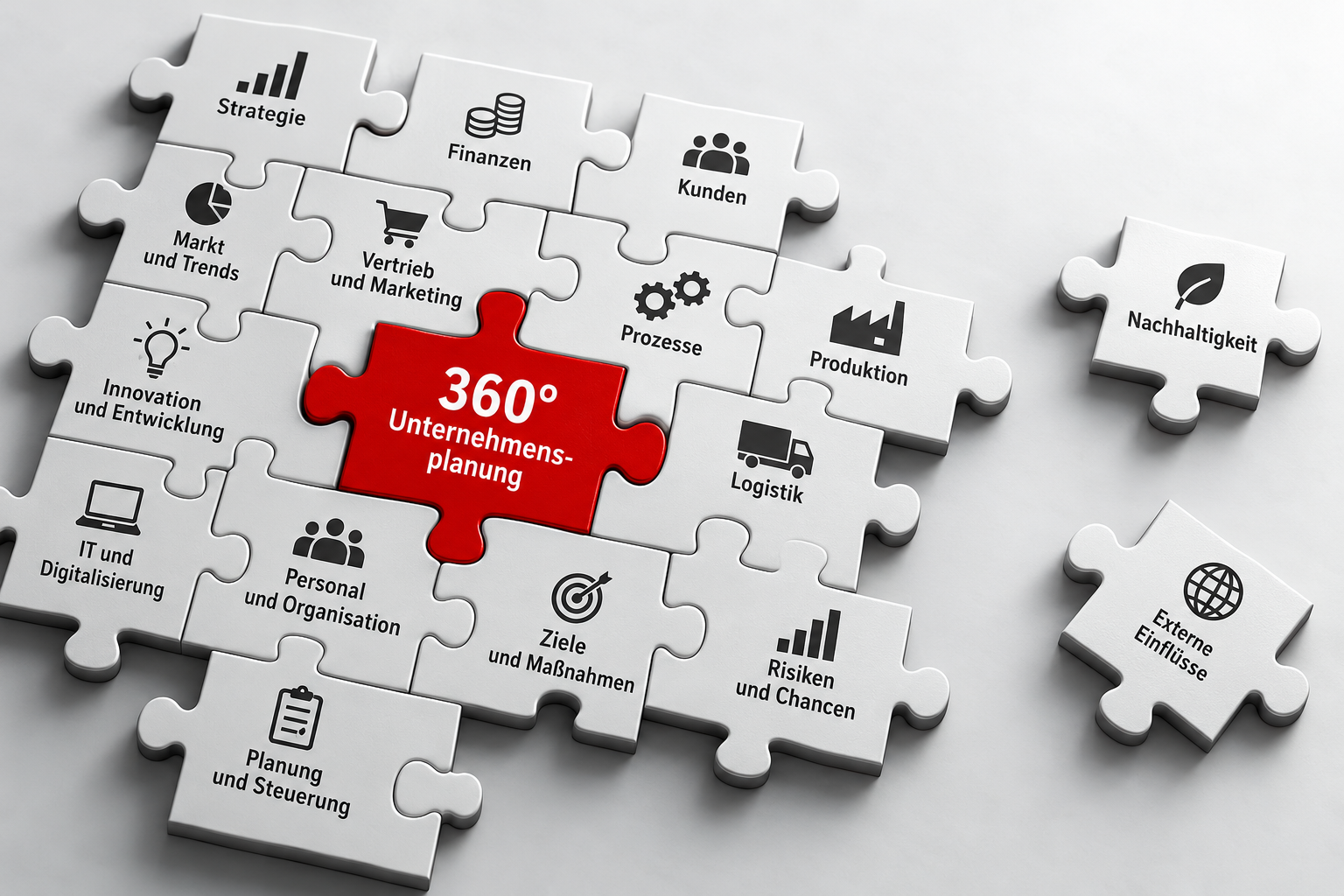
Why Integrated Business Planning Paves the Way for the Future
Companies need to respond ever more quickly to changing market conditions. Integrated business planning connects strategic objectives, operational actions and financial implications into a coherent whole. It provides an important foundation for informed decisions and prepares the business for the future.
Digital transformation, demographic change, geopolitical uncertainty, competitors closing the technology gap and changing customer expectations present companies with a wide range of challenges.
What worked yesterday will not necessarily work tomorrow when conditions change.
Medium-sized industrial companies, in particular, need to critically examine established structures and familiar ways of working. Individual improvements are often insufficient because changes in one part of the business have direct implications for others.
Integrated business planning addresses precisely this challenge. It takes a comprehensive view of the company and connects its strategic direction with operational and financial plans.
Why maintaining the status quo is not an option
For many years, companies could rely on established structures, longstanding customer relationships and proven processes.
In a relatively stable market environment, it was often enough to improve existing processes incrementally and respond to changes as they became apparent.
But market conditions change. New competitors, technological developments and changing customer requirements can put increasing pressure on previously successful business models.
Companies therefore need to regularly question whether their structures, processes and capabilities still meet future requirements.
This raises some fundamental questions:
- Market position: How competitive are our products, solutions and business models?
- Organisation: Do our structures support the future development of the company?
- Processes: Which activities genuinely create value, and which generate avoidable work?
- Capabilities: Do we have the skills and resources we will need in the future?
- Strategy: Are our existing objectives and approaches still viable under changing conditions?
Answering these questions requires a perspective that extends across departmental boundaries.
Optimising individual parts of a business does not necessarily improve its overall performance.
A comprehensive view as the foundation
Integrated business planning means considering the company as a whole and aligning the plans of its individual functions.
The starting point is a clear vision of how the company should develop over the long term.
Strategic objectives and concrete actions follow from this vision. They must then be reflected in the operational plans of each function.
These include:
- Sales and marketing: Market development, target customers, sales volumes, revenue planning and market positioning.
- Production and service delivery: Capacity, utilisation, productivity and delivery capability.
- People and organisation: Workforce requirements, capabilities, leadership structures and organisational development.
- Product development and innovation: Technological development, investment and future customer requirements.
- IT and digitalisation: Systems, data availability and support for business processes.
- Finance: Profitability, the balance sheet, liquidity, investment and funding requirements.
Having a separate plan for each function is only a starting point. Those plans need to share common assumptions and be connected in substance.
This is how a consistent picture of the company’s future development emerges.
Systematically incorporating external developments
Business plans often rely heavily on historical results.
Past revenues are projected forwards, cost trends are extrapolated and existing market positions are assumed to remain largely stable.
This approach can become problematic when external conditions change fundamentally.
Technological developments, new competitors, geopolitical shifts, regulatory requirements and social trends can have a significant impact on future business performance.
External factors should therefore be incorporated systematically into planning.
Useful tools include market and competitor analysis, industry comparisons, technology trend analysis and the exploration of different future scenarios.
Benchmarking can also provide valuable insights. However, the companies and metrics being compared must be genuinely comparable, with differences in business models, levels of vertical integration and market positions taken into account.
Robust business planning needs to consider possible future changes alongside historical performance.
Aligning plans across functions
A significant problem in many companies is that individual functions develop their objectives and actions largely independently of one another.
Sales may plan for increasing revenues and promise short delivery times, while production lacks the necessary capacity and workforce plans and investment have yet to be adjusted accordingly.
Such inconsistencies can lead to delivery problems, additional costs and dissatisfied customers.
Integrated planning therefore connects the objectives and actions of all the functions involved.
Higher sales volumes, for example, must be reflected in capacity planning, material requirements, workforce planning and, where necessary, additional investment.
The financial implications must also be taken into account.
Regular coordination across functions helps identify dependencies early and resolve conflicting objectives.
This produces more realistic plans and a shared understanding of business priorities.
Proactive marketing and sales
Actively developing future market opportunities is an important part of integrated business planning.
In favourable economic conditions, many companies could rely on existing customer relationships and incoming enquiries.
In more challenging markets, this approach is often no longer sufficient.
Marketing and sales need to work together to analyse which markets and customer groups offer attractive future business opportunities.
Marketing helps identify relevant developments, make the company’s capabilities visible and engage potential customers at an early stage.
Sales develops these relationships, identifies specific challenges and works with customers to develop suitable solutions.
This requires close coordination with product development, production and other business functions.
The resulting market and revenue plans, in turn, provide an essential foundation for planning across the company.
Realistic revenue plans should be grounded in identifiable market opportunities and concrete actions, rather than desired growth rates alone.
Continuously reviewing and improving processes
Integrated business planning extends beyond setting future objectives.
It must also consider whether existing business processes are capable of delivering them.
Processes that have evolved over time, unclear responsibilities and gaps in coordination between departments can significantly undermine a company’s performance.
Processes should therefore be reviewed regularly for effectiveness and efficiency.
Cost reduction is only one consideration.
Shorter lead times, higher quality, stronger customer focus and the ability to respond flexibly to change are equally important.
Examining processes across functions is particularly valuable, for example from initial customer contact through quotation and order fulfilment to invoicing.
This often reveals weaknesses that remain hidden when departments are considered individually.
Integrated financial planning brings the elements together
All strategic and operational plans ultimately need to come together in a consistent financial plan.
This includes an aligned profit and loss forecast, projected balance sheet and cash flow plan.
The planned development of the business must be clearly reflected across all three.
Rising revenues may, for example, require additional production capacity, higher inventory levels or more employees.
These changes affect profitability, capital employed and liquidity.
Investment, funding requirements and potential changes in working capital must also be considered.
Integrated financial planning makes these connections visible at an early stage.
The credibility of the underlying assumptions is particularly important.
What revenue can realistically be achieved? What costs will the planned actions generate? When will investment result in cash outflows? What will the implications for liquidity be?
Different scenarios should also be explored to assess the impact of less favourable market conditions.
A transparent financial plan is also an important foundation for discussions with banks, investors and other funding partners.
Connecting strategy, operational actions and financial implications creates a robust foundation for business decisions.
Planning as an ongoing management process
Integrated business planning should be treated as an ongoing responsibility throughout the year.
Particularly in a dynamic market environment, planning assumptions need to be reviewed regularly and adjusted where necessary.
This includes continually comparing planned results with actual performance.
Variances need to be analysed for their causes and consequences, as well as recorded.
Which developments were unforeseeable? Which assumptions proved incorrect? Which actions need to be changed or supplemented?
Regular forecasts and scenario analysis help management adapt to changing conditions.
Integrated planning thus becomes an essential part of management’s work.
Creating the foundations for the future
A company’s ability to succeed in the future depends heavily on how well it adapts to changing market conditions.
Integrated business planning provides an important foundation by connecting strategic objectives, external developments, operational actions and financial implications.
It helps identify conflicting objectives, allocate resources effectively and base business decisions on clear, credible assumptions.
This requires a willingness to critically examine existing structures and ways of working, and to consistently strengthen collaboration across the business.
Taking an integrated approach to planning and managing a business improves its responsiveness to change and creates the conditions for actively shaping its future.