
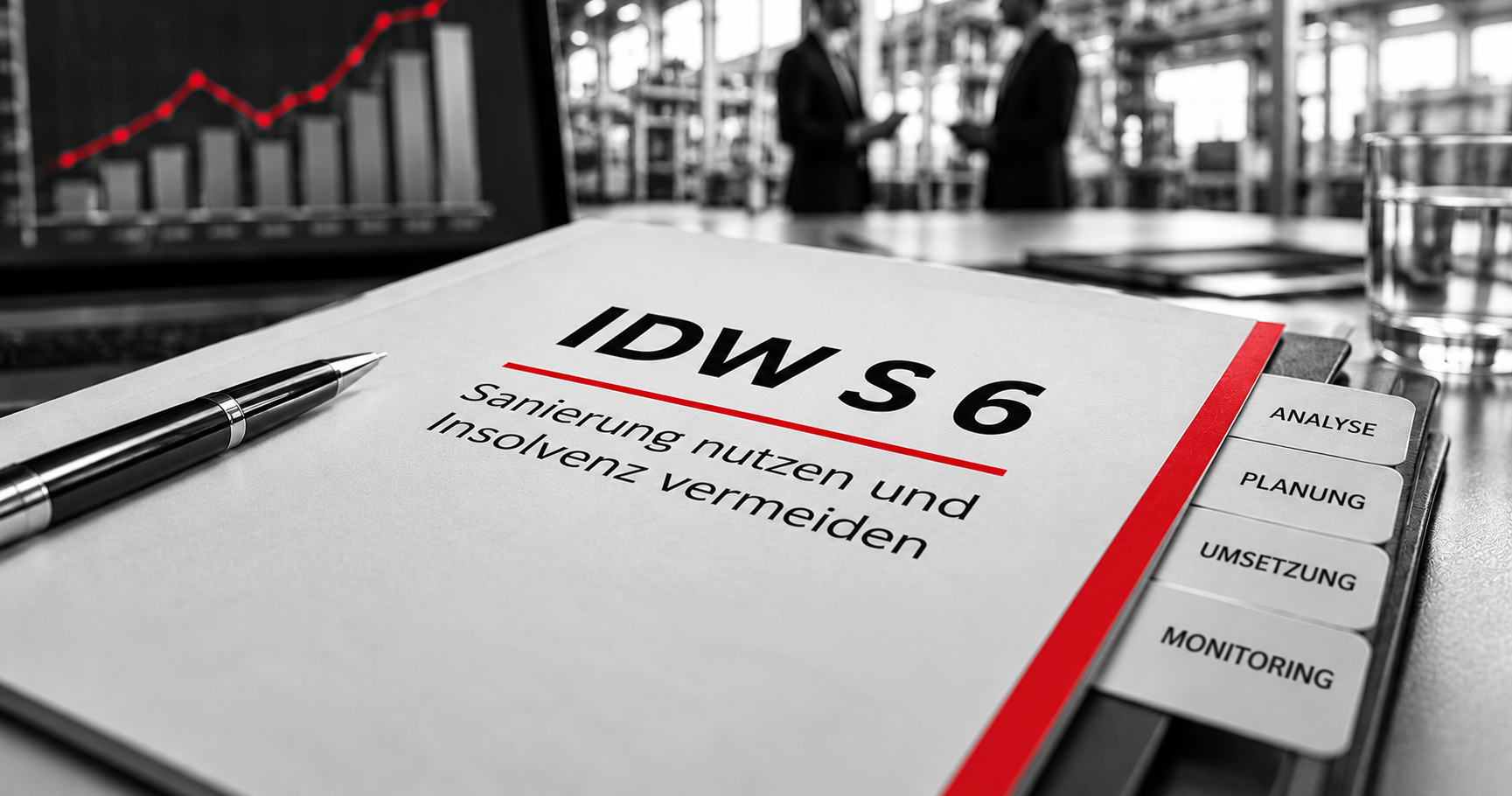
IDW S 6 – A Box-Ticking Exercise or an Opportunity?
When small and medium-sized businesses encounter financial difficulties and need support from lenders, a restructuring report prepared in accordance with IDW S 6 is often required. Banks are obliged to monitor their borrowers’ risk and therefore need transparency. They request a report to assess whether the business can continue operating. For many business owners, however, after years of working closely with their main bank, this report feels like an unwelcome formality – a procedural step to buy time and secure the requested financing.
Yet viewing IDW S 6 merely as a necessary evil overlooks its real potential. A carefully prepared restructuring report can offer much more: it sets out a path towards a sustainable strategic realignment and, in many cases, marks the turning point on the road out of a crisis.
In small and medium-sized industrial companies in particular, crises rarely emerge overnight. They develop over years, often gradually and unnoticed. The causes can be varied:
*The loss of a major customer accounting for a substantial share of revenue.
*Declining markets caused by geopolitical changes or a loss of international competitiveness.
*Sharp increases in energy, material or logistics costs that put significant pressure on margins.
*Skills shortages and the loss of expertise, slowing innovation and undermining delivery reliability.
*Insufficient strategic adaptation, as business models respond too slowly to technological, societal or regulatory changes.
Many small and medium-sized businesses have outstanding engineering capabilities, as demonstrated by Germany’s large number of global market leaders. However, they are less likely to have structured approaches to identifying and entering new markets. A downturn in their main market or the loss of an important customer can therefore have a rapid and substantial impact. In these situations, treating a requested report as a mere formality is not enough. What is needed is a substantive restructuring plan that is actively embraced and implemented. Otherwise, lasting improvement is unlikely.
The formal framework – and its limitations
The IDW S 6 standard issued by the Institute of Public Auditors in Germany sets out clear requirements for the structure of a restructuring report:
*A description of the initial economic situation and the stages of the crisis,
*An analysis of the causes and an assessment of the business’s ability to achieve a successful turnaround,
*An analysis of its financial position, earnings and assets,
*And a credible restructuring plan with measures, a timetable and progress monitoring.
In practice, however, this structure often results in a purely procedural approach. Figures are collected and plans drawn up, but a forward-looking business perspective is missing. The report meets all the formal requirements yet fails to fulfil its real purpose: restoring the company’s long-term viability.
The real objective is to shape the future, rather than simply explain the past
A restructuring report prepared in accordance with IDW S 6 should be the starting point for a fresh start, rather than a record of failure. The central question is therefore: “How can the company become competitive and resilient again?”
For small and medium-sized industrial companies in particular, this means understanding the causes of the crisis precisely. Does the problem lie in the product portfolio, cost structure, sales function or strategic positioning? Which markets offer future opportunities, and which should the company perhaps leave?
A good report therefore identifies weaknesses, sets out clear options for action and explains transparently which measures will make a difference. It quantifies their effects on liquidity, earnings and equity.
Banks expect more than a mandatory document
Banks and credit insurers have also changed their perspective, placing greater weight on qualitative aspects of management than in the past. A formally correct report with weak substance is no longer convincing. Finance providers want to see that management understands the crisis, is capable of taking action and is prepared to make the necessary decisions.
A good IDW S 6 report therefore provides an actionable implementation plan, rather than mere reassurance. It answers questions such as:
*How can liquidity be secured in the short term?
*Which measures will establish sustainable profitability over the medium term?
*What strategic realignment is needed to avoid future dependencies – on individual customers, for example?
From report to transformation
A convincing restructuring report is the starting point for a transformation process. Small and medium-sized industrial companies often combine outstanding technical expertise with less structured sales or management processes. This creates considerable opportunities for a practical turnaround roadmap:
*Refocusing sales on target markets and profitable segments, using modern and efficient approaches
*Modernising cost and organisational structures
*Strengthening leadership and communication to embed change
*Using digitalisation and automation to improve efficiency and transparency
*Diversifying the customer portfolio to reduce dependencies
*Making effective use of modern marketing communications
Common pitfalls
Many turnaround attempts fail because of hesitant implementation rather than a flawed plan. A lack of prioritisation, unclear responsibilities or overly optimistic timetables can undermine otherwise sound approaches.
An effective restructuring plan therefore requires:
Honesty in the analysis – including towards oneself,
Transparency with stakeholders,
And consistent implementation, supported and actively directed by senior management.
Only then can a document become a real turning point.
Conclusion: your mindset determines whether this is a box-ticking exercise or an opportunity
A restructuring report is not an end in itself. It must become a strategic tool for renewal rather than remain a procedural exercise. Restructuring is also a business leadership responsibility that extends beyond financial matters. Business models need to be reconsidered, leadership strengthened and structures modernised. All stakeholders should be brought together, with openness and transparency maintained throughout the process.